The wet umbrella bag looks like a commodity until you order the wrong one. A lobby buys a case of long single-umbrella sleeves, then discovers half its rainy-day guests carry compact folding umbrellas that swim inside a 35-inch bag, or a retailer installs a stand sized for standard umbrellas and watches golfers jam oversized canopies into a chamber that will not hold them. Format is the decision that determines whether the system works on the wettest day of the year, so it deserves more thought than price per thousand. This comparison lays out the common bag formats and dispenser types side by side and shows which venue each one actually fits.
Three bag formats, three different umbrellas
Nearly every wet umbrella bag on the market falls into one of three formats, and they are defined by the umbrella they are meant to swallow. The short or folding-umbrella bag runs about 7 inches wide by 24 inches long. It suits the collapsible travel umbrellas most commuters carry, and because it uses less film, it is the cheapest per unit. The standard long bag, typically 7 inches by 35 inches, is the default for full-length stick umbrellas and the one most single-chamber stands are built around. The golf or large bag is the outlier: golf umbrellas span 54 to 68 inches of canopy arc when open and stay bulky when closed, so their bags run wider, often in the 11-to-13-inch range, and longer, around 37 to 40 inches. Those golf figures vary more between suppliers than the standard sizes, so treat them as indicative and confirm against a sample.
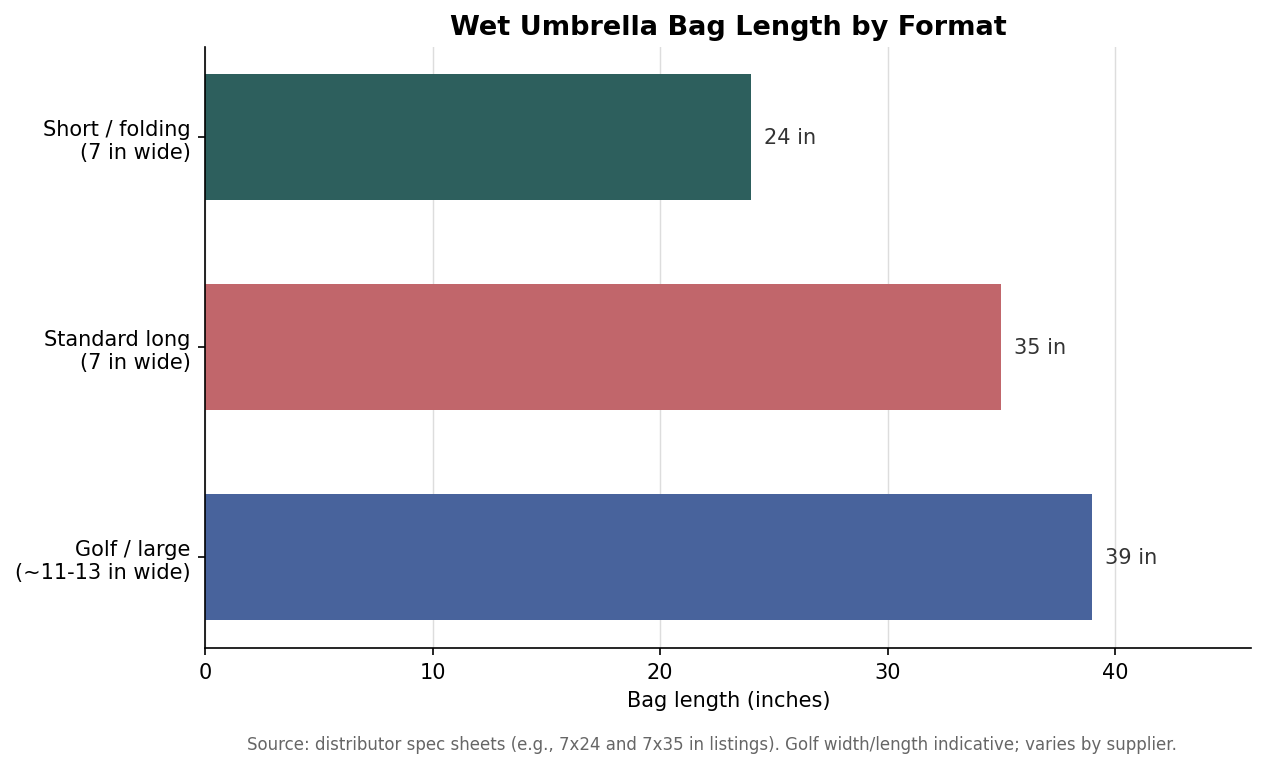
Width matters more than buyers expect. A folded golf umbrella forced into a 7-inch bag either tears it or refuses to seat, which is exactly the moment a dripping umbrella ends up loose on your floor. If your venue draws a meaningful share of large umbrellas, a wider bag or a dedicated golf chamber is not a luxury; it is the difference between a dry entrance and a slip claim.
Film thickness is a durability decision, not a spec to minimize
Umbrella bags are thin by design, generally between 0.5 and 1.0 mil of polyethylene. Thinner film, around 0.5 to 0.7 mil, dispenses cleanly and costs less, and it is fine for a self-service stand where guests take a bag and move on. The failure mode to watch is the golf and stick-umbrella crowd: a sharp ferrule or a stiff rib tip will puncture 0.5 mil film more readily than 1.0 mil, and a bag that splits halfway to the elevator has done nothing useful. As a rough rule, match thinner film to folding-umbrella traffic and step up toward 1 mil where large umbrellas dominate. Compostable films behave differently and usually run thicker to hit the same tear resistance, which is a separate materials conversation from the polyethylene formats compared here.
Single stand or double wrapper
The dispenser you choose has to match your format mix. A single-chamber stand has one insertion slot sized for standard umbrellas and, in common models, holds on the order of 3,000 bags before a refill. It is the right call for an office lobby or a boutique where nearly everyone carries a standard umbrella and simplicity matters. A double or automatic wrapper puts two chambers side by side, one for standard umbrellas and one for short folding umbrellas, each holding roughly 3,000 bags in typical units. That second chamber is the point: a hotel or a transit-adjacent retailer sees both umbrella types in volume, and a double unit lets a guest bag either without fumbling. The tradeoff is footprint and a higher up-front cost for the stand itself, plus the need to keep two bag sizes stocked instead of one.
Whatever the stand, plan the refill interval around your worst day, not your average one. A unit rated for 3,000 bags sounds bottomless until a daylong storm pushes a few thousand people through a single entrance and the chamber empties by mid-afternoon. Buying a case ahead and staging it near the stand costs little and prevents the scene where staff are hand-tearing bags at the door.
What the formats cost, and where custom printing fits
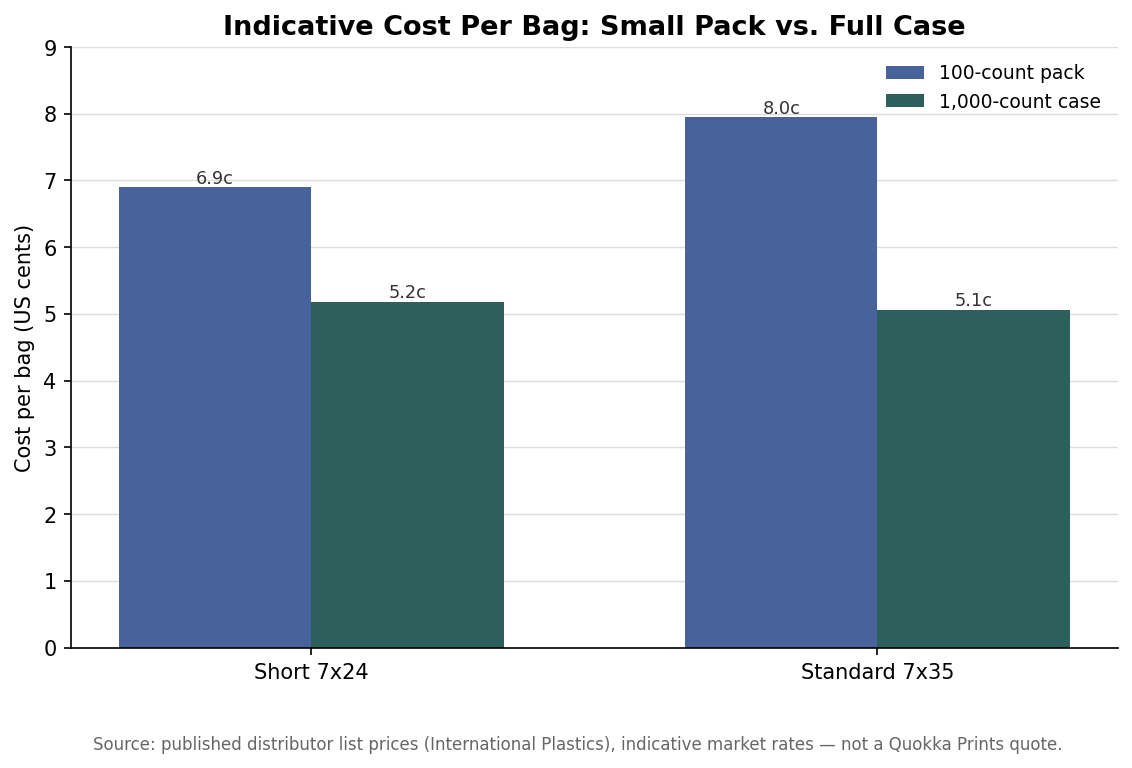
Per-bag economics reward buying by the case. Published distributor pricing puts small 100-count packs in the range of roughly 7 to 8 cents a bag, while the same bags in 1,000-count cases fall to about 5 cents, a drop of a quarter to a third simply for ordering the larger quantity. Those are indicative market figures from a national distributor, not a Quokka Prints quote, and custom-printed stock carries its own setup and minimum-order considerations on top of the blank-bag baseline. The takeaway is directional: order in case quantities, and size your first custom run against a realistic season of use rather than a cautious trial that lands you at the higher per-bag tier.
Printing changes the bag from a floor-safety expense into a branded touchpoint, since every guest carries your logo from the door to wherever they are going. Two practical notes when you specify a custom print. Keep artwork on the flat body of the bag where it reads clearly, and remember that a bag is nearly always seen wet and stretched around an umbrella, so high-contrast logos and short text hold up far better than fine detail. And match the printed format to your dispenser before you commit to a run: a beautifully printed standard bag is wasted inventory if your stand is a double wrapper begging for a short-bag refill.
Put the pieces together and the decision is short. Read your entrance for the mix of folding, standard, and golf umbrellas, choose a single stand only if one format truly dominates, step film thickness up where large umbrellas are common, and buy in case quantities sized to your rainiest realistic day. Get the format right first, and the printing and pricing questions become easy.